-
The folly of the 1.8%
“But we are only 1.8%” and other denier delusions.
A few years ago, one could meet people who would flat-out deny the climate was changing. Just- “No it’s not. Nyah nyah. You are an alarmist.” Their numbers have diminished as the evidence mounts, but the immense influence of fossil fuels has ensured that some deniers still hang around.
I divide the deniers into two broad groups, the Ignorant and the Adamant. The Ignorant aren’t stupid, necessarily-they just don’t know. They don’t understand the science, because it’s hard. They don’t know whom to believe, because they haven’t read Blog #2. They are perfectly decent people, most of them, and they are just confused and worried. We can reach these people not by shouting at them and getting in their faces (which is what I generally do) but by providing them key bits of information, by giving them the tools by which to learn. There is a lot of good psychological research explaining why it is so hard to convince people with facts. Turns out there is something called “motivated reasoning”, in which new information is instantly countered with a subconscious negative. This is believed to be a survival mechanism left over from our Paleolithic forebears, one that instantly countered new or threatening information with a countervailing response. The result is that, when we think we are being scientists, we are really being lawyers.
This gets worse. In broad terms, humans may be classified as “hierarchical” or “egalitarian” in their outlook. In the US, these groups would be conservative Republicans and liberal Democrats. In Canada, it’s not so clear, but one could guess that adherents of the PPC (People’s Party of Canada) would fall into the hierarchical group, and-if there are any left-members of the Green Party would be egalitarian.
This presents enormous difficulties when trying to communicate the threats posed by AGW (Anthropogenic Global Warming). For example, when presented an example of an opinion on climate by an expert in the field, only 23% of heirarchicals accepted the expert’s credentials, whereas 88% of the egalitarians had no problem.
In other words, some people will reject the validity of the source of scientific data if it conflicts with their deeply-held views. How in hell can we get around this? Confronting holdouts with hard data may in fact result in a hardening of their views. And it gets worse again. Back in the good old days, every village had an idiot, and the people knew to give the idiot a wide berth. Now, when any moron with a mouse can make mischief, people can seek out “news” and opinions that comfort them. Getting information from Facebook or Twitter or Fox News or The Rebel may be comforting to some, because “a man hears what he wants to hear, and disregards the rest”, but this makes it very hard to penetrate and communicate. Cherry-picking leads to motivated reasoning. And it’s not just the Right that is capable of holding outrageous views in the face of all the evidence: “If you want to find vaccine deniers, all you have to do is hang out at Whole Foods” (Mnookin, 2020).
If we want reluctant people to understand climate change, then we need to ensure that we present the information in a way that does not challenge their core beliefs, one that does not trigger their automatic defense mechanisms. So No, Mike, don’t yell at people- ask them what might change their minds, ask them what they really believe.
Of course, up until now we have been talking about the Ignorant. There may be hope that their minds can be changed. There is little we can do about the Adamant, because these people are just selfish assholes who are too wedded to fossil fuels to bother listening. They are the ones who will, predictably and monotonously, spout phrases like “We are only 1.8% of global emission” and “But China.” It then becomes our job, every time this nonsense surfaces, to bat it back down, hard, with facts. We won’t change the Adamant’s mind, but we will alert anyone else listening or reading.
Let us start dismantling the 1.8% argument, because it’s the epitome of selfish stupidity. Yes, Canada right now contributes “only” 1.8% of global emissions. Does that mean we get a reprieve? If so, then so does Turkey (1%), Iran (2%) and Mexico (1%). In fact, all the countries with emissions down around Canada’s sum to about 25% of the global total-far more than the US, and just under China, at 29%. So, selfish and dumb. But we aren’t done yet with these goomers.
The 1.8% argument is the precise moral equivalent of being one of 20 people in the hot tub, and saying “It’s OK if I pee in the hot tub because I am only a small percentage.” It is the exact moral equivalent of driving down the highway, throwing your cup out the window, and saying “The last 20 cars also did this, so I can too.”
“But we are a big, cold country.” Sure. And our per capita emissions are twice those of Iceland and Finland, four times those of Denmark and the Ukraine, and 5 times higher than Sweden. And enough of the “big country” bullshit. 90% of Canadians live within 100 miles of the US border.
The 1.8% argument is just a way of saying, I want everyone else to go first. Irredeemably selfish. But it’s also dumb. The warming of the planet is a function of the total CO2 we have added. In order to keep warming levels low enough that our civilization has a chance of surviving, it is obvious that the total atmospheric content of CO2 is the driving factor. Imagine for a moment that the levels of CO2 in the atmosphere need to be kept below 100 units. Then imagine some country saying “We have already produced 99 units, but we’re not producing as much now, so we will leave it to you guys to solve.”
That is precisely the 1.8-ers position, and it has recently been eviscerated by Carter and Dordi, 2021, in a technical paper for the Cascade Institute (Univ. Waterloo). They analysed Canada’s past and projected fossil fuel production-and the results are sobering. With 0.5% of the world’s population, our 2021-2050 production would exhaust 16% of the planet’s remaining carbon budget. Canada is a carbon bomb of global significance. The paper goes on to point out (and this will surprise no one) that the oil and gas lobby plays a dominating role in Canadian policy, obstructing supply side policy implementation. In the first year since the onset of the Covid pandemic, fossil fuel industries and associations met with government officials a total of 1,224 times, or more than 4.5 times per working day.
The outsized influence of the fossil fuel lobby is a subject for another post. This one is already getting pretty long, so I will spend a few sentences on “But China.”
First of all, China has a plan, and is on schedule. Even though they will have started at a much lower base, they plan to be at Net Zero just a few years after us. I think this rapid response on their part has to do with two factors: first, China’s governing elite are mostly engineers, not the lawyers and economists that dominate (litter) many other governments. This means they understand the issues, and their importance, whereas in Canada the scientists have to wade through an endless mass of bureaucrats (none of them scientists) until they get to decision makers. Never forget: year after year, DFO scientists recommended catch sizes for Cod off our East Coast, and year after year the Conservative government replaced those recommendations with catch sizes that were two and three times higher. Look where that got us. The other reason China can move so quickly, to be frank, is that their authoritarian government doesn’t have to do a lot of consulting.
I don’t worry as much about China as I do about India and the US. India’s a mess, a huge, chaotic country ruled by a religious fanatic. (What could possibly go wrong?) Right now (April 2022) they are cozying up to Russia because they want oil at discounted prices. (War crimes? What war crimes?) The planet’s ace in the hole here may be that neither China nor India can feed their people. They both depend on imports of food. Much of India’s agriculture depends on water from the Himalayas, carried down by the great rivers of SE Asia, the Indus, Ganges and Brahmaputra. Some of their water is shared with neighbours like Pakistan and Bangladesh. Climate change will result in huge drops in the amount of food India can produce. Governments faced with mobs of starving people may be open to negotiations-or, they could use their nukes.
The US is another sort of problem. Their fractured politics almost ensures nothing much will get done soon. A few crop failures in Red States may make them see the light.
Now we know how to deal with “We are just 1.8%”. Next, a blog on beer. Partly.
-
Natural infrastructure in Grey-Bruce
This week’s blog post is by Nikki May, who has a degree in science, a Master’s in Forest Restoration (U Guelph). She is a dedicated conservationist and naturalist. There will be several from her on this theme-this is the first one.
Blog #3 – Climate Matters
Natural Infrastructure in Grey and Bruce
Think of a tree. You are sitting under the tree on a warm summer afternoon. You hear the hum of insects and the twittering of birds. Most people think trees are beautiful. But have you ever stopped to think what a tree does for you and for the fellow creatures who share our habitat?
A tree provides you with oxygen to breathe. It absorbs carbon dioxide, one of the most worrisome greenhouse gases in this time of rapid climate change. The tree also absorbs a great deal of water from the ground and thus helps to reduce flooding in times of heavy rains. The tree transpires or evaporates a great deal of water as well, as water carries the nutrients it needs up from the soil to its leaves. As a result, a tree can continually carry water away from the ground. In times of drought, trees in large groups can transfer enough moisture up into the atmosphere so that they ‘create’ their own rain. The Amazon rainforest is particularly good at this. Trees also help to filter the water that they don’t absorb as it travels through the soil to the groundwater from where we draw our drinking water. And a tree provides us with shade to cool us, our surroundings, and our homes, on hot summer afternoons.
The tree also provides food for the insects you hear. Many of these insects provide pollination services so that you can enjoy fruits, vegetables and obtain seeds for next year’s garden. The insects provide food for the birds, who in turn help control insect pests, add beauty and interest to our lives, and provide food for animals higher up the food chain.
All these things and more that trees do for us we call ecosystem services. And trees are only one part of the natural world that provides humans and other creatures with these services. Wetlands, meadows, rivers and streams, the plants growing in them and the animals living there, all provide us with the basic services we need to survive. Air to breathe, clean water to drink, soil to grow our crops, pollination services and much, much more. All these things together are what we call natural infrastructure.
Like built infrastructure – think roads, water supplies, electricity; natural infrastructure such as grasslands, woodlands, wetlands, lakes, rivers and streams, makes our lives possible. In fact, natural infrastructure is far more important to us than built infrastructure because natural infrastructure provides us with the basics we need to live. Think of the first peoples that came to this land ten to fourteen thousand years ago, and then the waves of humans that followed. Before the glaciers retreated, and for a long while afterwards, humans were not able to live here. The natural infrastructure that provided them with food and habitation did not yet exist. There was air to breathe, but no running water at first, and then no food for a long while after the glaciers retreated. Only when plants started to grow and animals appeared were humans able to live on this land.
Today in Grey and Bruce Counties, we are very fortunate to still be surrounded by a rich variety of natural infrastructure. Although many of our wetlands have been filled in, many still remain. Our lakes and streams are relatively clean and we have many woodlands and meadows on the landscape. The health of our natural infrastructure is illustrated by the richness of the bird life we find here, the relative fertility of our soils, the variety of frogs that we still hear in the wetlands, and the fact that there are still lots of black flies and mosquitoes in the spring, bees and butterflies in the summer and dragonflies, damselflies and moths throughout the warmer months. We need to protect these rich resources that sustain us, and take advantage of them when we build new housing developments. If we build around our woodlands, wetlands and flloodplains and incorporate them into our infrastructure system, we will be rewarded by having resources which not only improve in performance with time but sequester carbon and provide us with beauty and relief from mental stress whenever we walk by a stream, through a meadow, or sit under a tree.
Submitted to Climate Matters Blog by
Nikki May
-
A roadmap through the climate disinformation jungle.
Blog #2: A roadmap through the jungle.
In our process through the pandemic, we saw how easily misinformation spreads and is able to convince some people. There has been a lot of recent psychological research establishing that “polarized individuals may simply be less good at considering evidence contrary to their own views, and are more apt to swiftly disregard the opinions of their opponents.” Which is another way of saying that people sort themselves into tribes, and dig in when their tribe is threatened. I run into climate deniers all the time. My usual response, diplomat that I am, is to yell “How can you be so G-D stupid?” This is usually ineffective. What seems to help, in some cases, is to give people a set of tools that will help them dig out information, to separate fact from fiction. The disinformation that so roiled our society during the pandemic was not well funded, compared to the firehose of bullshit funded by Big Oil. More on this in a later blog post, maybe, but for now: although much of the money is hidden from view, estimates are that the amount Big Oil spends on disinformation is about the same as the advertising on beer: billions.
To counteract the influence of all this fossil fuel propaganda, we need to give people the tools to see behind the screen, to suss out the truth. That’s much more effective than me just yelling at them. So let’s start arming people so they can tell good science from bullshit.
The first thing to understand is: all science depends on the scientific literature. When we have some results we think are worth it, we write them up in a “manuscript” (because it’s not yet a paper), and send it to a journal. There are many grades of journals, from the outstanding (Science and Nature) to the mediocre. There has also arisen a class called Predatory Journals, which will print any old crap as long as they are paid. The best journals have been around for years, and are mostly published by professional societies. When a journal gets a manuscript it sends it out to reviewers, generally 2-3, with expertise in the field. Their job, to be blunt, is to tear the thing apart. The reviewers send their reports (Reject, Reject with Minor Revisions, Reject with Major Revisions) back to the Editor. Most manuscripts require some revision, some are rejected outright.
The system is far from perfect. Reviewers have prejudices, as do Editors. But at least if a paper appears in a real journal, then you have the confidence of knowing it has passed a minimal level of scrutiny. There is no quality control on Youtube videos or websites. If a large number of papers come to the same conclusion, then it’s reasonable to bet that it’s the correct one. Michael Mann’s “Hockey Stick” temperature reconstruction has come in for a pile of attacks, but over the ensuing decades, the results have been verified by about 6 other research groups.
So here’s Rule #1: always check the refereed literature. An excellent source here would be Google Scholar. There are other compendia, such as the Web of Science, but those are usually behind paywalls.
Rule #2: always check the person. If someone tells you “Trust me, I am a climate scientist” and then says something a tad hinky-check them out. Google Scholar will bring up every paper they have ever written. There may well be some revelations. Then check their support. You can find a list pf prominent deniers, and their sources of support, at DeSmog. There are also a whole raft of fossil-fuel funded websites with wonderful-sounding names, and base motives, such as
Friends of Science (who could be AGAINST science?)
American Enterprise Inst
Cato Inst
Centre for the Study of Carbon Dioxide and Climate Change
Global Climate Coalition
Prager U (which isn’t a university)
Principia Scientific
…and on and on. There are hundreds of these. They are all fronts for Big Oil. Use the resources at DeSmog, Skeptical Science and Sourcewatch to follow the money. When you find Heartland Inst, Koch Industries, or any of the other hinky funding sources, you know you are not dealing with people who have your best interests at heart.
The Americans have 1000’s of paid shills, as befits the size of their fossil fuel industry. Again, you can find out someone’s cred, using the resources above. Some are sort of funny. President Trump picked Dr. William Happer, an Emeritus Prof at Princeton, to be on his National Security Council. He got caught in a Greenpeace sting, offering to write puff pieces for coal companies. He charged $250/hr.
Not to be outdone, Canada has its own share of shills.
Tim Ball has a PhD in geomorphology (the study of landforms), has never published any climate science, is funded by Heartland-and is cited by the CCP as a science advisor.
Tom Harris is an engineer who got started writing copy for cigarette companies. He has then gone on to be an articulate denier, often seen in the National Post. Never published any climate science.
Susan Crockford is a BC biologist who can always be counted on to say the polar bears are doing just fine. Problem is-you guessed it-her speciality is dogs, and she has never, ever, published a paper on polar bears.
You get the picture. We are dealing with a firehose of disinformation, funded by the largest commercial entity the planet has ever known. We need a roadmap to help us through the fog.
There are some good sites. Realclimate is run by real climate scientists, and is not too technical. Sou’s HotWhopper is a wonderful site, characterized by her acerbic humour. She seems to have gone dark for a while-we all hope to see her up and posting again, but in the meantime I direct you to her archives. Peter Sinclair does Climate Denial Crock of the Week, and is always interesting. A couple of others I find interesting are Open Mind, and And Then There’s Physics. Then of course there are the data-rich sites run by governments, such as those by NOAA, NSIDC, Danish Met Survey, British Met Survey. Etc. None of these takes any money from industry, which leads me to
Rule #3: follow the money. Always dig down to see who is funding what you are reading. You will be amazed, and very depressed, by the crap that’s out there.
Which leads me to a good time to wrap up this post. I hope I have convinced you to trust the science. We could all make far more money shilling for oil than we could writing blogs, so it’s just dumb to even begin to think that this “climate hysteria” has all been cooked up by the world’s scientists so they could make more money. There are tools you can use to navigate the labyrinth out there. Use them. Remember:
-check the literature
-check the person
-follow the money.
Mike Risk Mar8/22
-
How science works-sort of.
Blog #1: An introduction to how science works.
As I write this (late Feb. 2022) Russia has just invaded the Ukraine. My head is full of rage and sorrow, and it’s hard to concentrate. I keep thinking, if the world had listened to the world’s climate scientists years ago, Europe would now be on renewables, Putin would have no nestegg and no leverage. I can put it no better than did the climate scientist Svitlana Krakovska last Sunday, at the UN climate meeting: “Human induced climate change and the war on Ukraine have the same roots, fossil fuels, and our dependence on them.” The way we are headed threatens all life on earth.
Several years ago, some municipalities around here declared “climate emergencies.” Perhaps they thought that was enough., because so far there has been precious little action on this front. A small group of us here in West Grey, fed up with lack of concrete results, have decided to vent our feelings and spread our limited knowledge by producing this blog. There is no schedule-posts will appear when we write them. The frequency will be determined by our time and energy-this is totally an unpaid, volunteer effort. We hope you will find the contents interesting, perhaps illuminating, and that we will in some small way get things finally moving.
I’m Michael Risk, and I have volunteered to write the first piece, because I think you, my friends and neighbors, could stand to learn a bit more about Science and the people who do science. This is another area where disinformation is rife. I am a retired McMaster Prof. and I have been lucky enough to work in many fascinating fields of science. To the best of my knowledge, I am the only climate scientist north of Guelph. I won’t bore you with my life history. If you would like to have a look at what I have done over the years, here is a link to my Google Scholar site: https://scholar.google.ca/citations?user=Ayaf5QoAAAAJ&hl=en
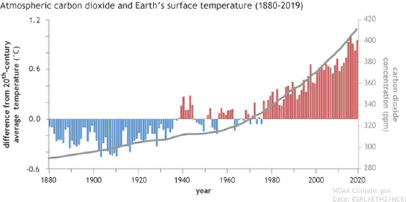
As I write this, we seem to be slowly returning to normal after a long couple of years of our lives being dictated by a virus. As we raise our heads above the parapet and gaze around with fearful optimism, we will shortly be reminded that we have serious work yet to do, serious issues to deal with. During the time we were busy dealing with lockdowns and vaccinations, and with the frightening realization that there are deep divisions in our society, the planet continued its inexorable warming. Physics doesn’t care about our preoccupations.
One of the most distressing aspects of our time in Covid was the fault lines that opened up in our society, pitting vaccinated against the unvaccinated. Each side tried to support its case by citing science. There was a depressing and infuriating barrage of plans and counterclaims, with a great deal of misinformation and disinformation. [Misinformation is when you are mistaken, and disinformation is when you are lying.] This was a unique virus, one we had never seen before. We can all be thankful for the vaccines that saved so many lives.
We can see the same divisions of our society in the Climate Wars. Civil discourse seems to have given way to partisan divides, with both sides shouting past each other. The rise of the Internet has made this worse. Back in the day, every village had their idiot, and people knew to stay clear of them. Now, they can connect with one another-there is no idea so bizarre that some adherents can’t be found out there. This makes sorting into tribes much easier. We are also seeing the conflict between what have been termed the “Practicals” and the “Virtuals”-people who work with their hands, as opposed to people who stare at screens. This is not a firm division, of course. I would probably be called a Virtual, but I cut firewood and build houses. But I am also cursing my Macbook, because a recent system update managed to lose all my passwords and I can’t figure out how to get them back. But in general the division is based on education. The further ahead technology advances, the more those with little education are threatened. It will not have escaped the people in the sad, ill-advised Truckers Convoy that their jobs will disappear soon, with the rise of self-driving trucks.

Although we are not out of the woods yet, we can say that science has probably saved the lives of millions who would otherwise have perished from the disease. It would be no exaggeration to say that many more lives will be lost to climate change if we allow it to continue unchecked. It has been said many times that we have to ”Science our way out of this.”
We have learned of the looming threats from climate change from the work of scientists, and-if we “follow the science”-their work will help get us through the coming hard times. But-who are these mysterious people, and what motivates them?
There are about 90,000 government and university research scientists. That’s about 0.2% of the population, so the chances are very good you have never met one. And the chances are you wouldn’t recognize them in a crowd-because we are very normal people, not pencil-necked geeks with big heads. It all starts with interest-in something. How things work. Then long years at university. Almost every research scientist has a PhD, and many have done post-doctoral work before landing a job. That means 8-10 years in university: about twice as long as it takes to train a doctor, and three times that for a lawyer. The comforting thing to bear in mind is-no one ever went into science for the money. The same cannot be said for professions like Law, Business, Accounting…we are in it for love, not money.
We are, of course, paid in our jobs: but some figures may surprise. Consider two people with fresh BA or BSc degrees. One goes straight into teaching, and the other becomes (after a long, drawn-out process!) a professor. When the professor reaches their mid-50’s, their salary will finally equal that of the teacher-but they never make up the shortfall, from when they were in grad school living below the poverty line on Kraft Dinner and the teacher was making a decent salary. (I’m not really picking on teachers here, it’s just that the data are there.)
Take my own example. McMaster is one of the few universities offering Merit increases. These are hard to measure, sure, but the Committee looks at your publications, your teaching evaluations, and your service, and takes a shot at your raise that year. I did well, got large increases, published lots, was on the news lots, made it into some huge database of the world’s top 1% of scientists. The year that I retired, at the top income I ever made, my salary was less than that of an Ontario high school Principal.
We tend to enjoy what we do, and are for sure not in it for the money.
What we most like to do is research. That’s big fun. Finding out stuff. How do we get funded? The major funding agency for scientific research in Canada is NSERC, the National Science and Engineering Research Council of Canada. We conceive of a project, or a plan, that sounds interesting and important. We write a grant application to NSERC, and they have it assessed by a Grant Selection Committee. These are all fellow scientists, maybe with a bureaucrat thrown in the mix so the Panel doesn’t try to give away too much money. Not all grants are funded-far from it. The success rate in Canada hovers around 25%. In the US it’s depressingly low, around 10%.
I have reviewed grants from many different countries: US, Australia, UK, EU…the criteria are all very similar. Grants are evaluated on only a few criteria:
– Is the work important? No one gets funded for trivial work.
– Is the work original? No one gets funded to repeat the same old stuff we already know. -Is the budget reasonable, and can it be done?
And that’s pretty well all. From time to time there are attempts to “direct” science-the thought of politicians telling scientists what to work on is always good for a rueful laugh. About 10 years ago, in fields like Chemistry and Earth Sciences, if you proposed work that might help the oil companies you got funded, while “blue sky” research languished. But those attempts are, fortunately, rare.
There are strict rules governing how research funds may be used. The first rule, and one often not understood, is that we can take no income from grants. These are audited ruthlessly, by the universities and the feds, and if they discover someone has diverted any funding-there’s hell to pay. People have been fired. I once had a big project in the Bay of Fundy, looking at the biology of the intertidal flats, and trying to see what would be the impacts of tidal power developments. Yes, even back then we were thinking of alternatives. I really enjoyed the work, hired a bunch of smart kids who have all gone on to do well. We dug up critters with shovels (did I say this was high-tech work?) and counted them. When the field season ended, we drove back to Hamilton in a van full of mud and shovels. I could not take one of the shovels home to dig in my garden that Fall, because it had been bought with research funds. It had to sit in a closet until next Spring, rusting away.
What do we do with the grant money? We pay for analyses, for field work-and most important, we support grad students. These are smart young people, the next generation. They work on their research, supported by the prof, and do some teaching at the same time. Everywhere in the world, with the possible exception of North Korea, they live under the poverty line. That’s OK, because they are in a sense apprentices.
More to the point-why should you tax dollars help me do research? Because it’s a great investment. It is extremely hard to estimate the “worth” of research, but that hasn’t stopped people from trying. In the US, every $US spent by the NIH typically returns economic input worth $2.21, within the year. Other estimates are all over the map, with rate of return on investment ranging from 25% to 160% (Salter and Martin, 2001). Countries gain by supporting research, plain and simple. How are we doing?
Well, Canada’s SCIENTISTS do very well. We punch far above our weight internationally, producing 4% of the world’s scientific papers, and ranking #7 globally. Canada’s POLITICIANS have failed us miserably. We invest 1.6% of GDP in research, down from 2% in 2001-well below the OECD average of 2.5%, and well below our stated goal of 3%.
Diverting into the political for a brief moment: the only significant increase in science finding in Canada in recent years was during the brief Joe Clarke government. After that there were years of unmet promises, and then the crushing Harper years. Not only did his government cut funding-they diverted money towards oil companies and away from the environment. There was hope when the Liberals were elected-they SAID they were going to increase funding. Like many Liberal promises, this one fell short. It’s a real mystery to me why our governments have not stepped up…maybe if more people yelled at their MP’s about this, there would be change. Things might be better if we elected more scientists, but that rarely happens. The only examples I can think of are Margaret Thatcher (MA Chemistry) and Angela Merkel (PhD Quantum Chemistry)Physics), whose talents as leaders cannot be denied-but maybe that just means we need more women in politics.
Scientists are only human, and are certainly capable of the same mistakes and pratfalls as everyone. They can for sure be dishonest. One of my major areas of research is coral reef ecology, and coral reef biologists, especially in Florida, can resemble a nest of snakes-except that most snakes are benign. One well-known Florida reef biologist wrote papers stating that nutrients had no effect on reefs-while receiving more than $200,000 in consulting fees from developers who were discharging nutrients. Another, a man I consider a (sort of) friend, was retained by the US Navy in a court case. The Navy had been using the Island of Vieques, off the east coast of Puerto Rica, as a bombing range until finally a local NGO sued, saying the Navy was damaging the reef. This man testified that those funny-looking circular holes in the reef front had been made by-hurricanes.
Individual scientists are only human, but science as a rationale, a way of looking at life, is better than a collection of fallible humans. Science is self-correcting: we like nothing better than proving someone else is wrong, so every experiment, every paper, is scrutinized ruthlessly. When most of the world’s scientists believe in something, you can bet it’s valid. Sure, science deniers will say “consensus is not science”, but that’s just a way of saying “I choose not to believe what you say and I hope someday there might be evidence
-
Hello World!
Welcome to WordPress! This is your first post. Edit or delete it to take the first step in your blogging journey.
-
Subscribe
Subscribed
Already have a WordPress.com account? Log in now.
 Site TitleClimate matters, Grey-Bruce